Introduction
After end-of-life vehicles are dismantled and shredded, a large amount of Auto Shredder Residue (ASR) remains. This material contains plastics, rubber, textiles, glass, minerals and residual metals.
As landfill disposal becomes increasingly restricted in many markets, ASR is shifting from a disposal problem to a potential resource recovery opportunity.
An ASR recycling machine can help recover valuable metals from this complex residue while reducing the amount of material sent to landfill.
For dry processing, a typical ASR recycling plant combines screening, magnetic separation and eddy current separation to progressively classify the material and recover ferrous and non-ferrous metals.
What Is Auto Shredder Residue?
Auto Shredder Residue (ASR) is the mixed material left after end-of-life vehicles are shredded and valuable components and metals have been separated.
Depending on the source and shredding process, ASR can contain:
- Ferrous metal particles
- Aluminum and other non-ferrous metals
- Plastics
- Rubber
- Textile and fiber materials
- Glass
- Soil and mineral residues
The composition is not always consistent. Different vehicle types, dismantling practices and shredding systems can produce significantly different ASR streams.
This variability is one of the main reasons why ASR recycling equipment needs to be selected according to the actual feed material rather than based only on a standard machine configuration.

Why Is ASR Difficult to Recycle?
Recovering metals from ASR is more complicated than simply separating metal from non-metal.
Complex and Variable Material Composition
ASR contains a mixture of materials with different sizes, shapes, densities and physical properties. The proportion of metal can also vary between different feedstocks.
Fine Metals Can Remain in the Residue
Small metal fragments may become mixed with plastics, rubber, glass and mineral particles. If the separation process is not designed for different particle sizes, valuable metals can remain in the residual fraction.
Long and Tangled Materials
Wires, fibers, textiles and flexible plastics can become tangled around other materials or equipment components, making continuous processing more difficult.
Abrasive Materials
Glass and mineral particles can cause wear on screens, conveyors and other processing components. Equipment selection therefore needs to consider long-term operating conditions, not only initial processing capacity.
How Does an ASR Recycling Line Work?
A typical ASR recycling line can combine several stages:
Pre-Crushing & Liberation → Trommel Screening → Magnetic Separation → Air Classification → Eddy Current Separation → Gravity Separation
The exact configuration depends on the actual ASR feed and the recovery targets.
1. Pre-Crushing for Material Liberation
The first objective is not simply to reduce particle size.
A suitable crusher can help break apart larger material and expose metals that remain trapped inside plastics, rubber or other components.
For ASR with a high proportion of bulky or poorly liberated material, this stage can be particularly important.
2. Trommel Screen for Size Classification
After size reduction, a trommel screen can divide the material into different size fractions.
This helps downstream equipment process more uniform material.
For example, coarse and fine ASR fractions may require different separation conditions. A multi-stage trommel can therefore play an important role in preparing the material for subsequent recovery.
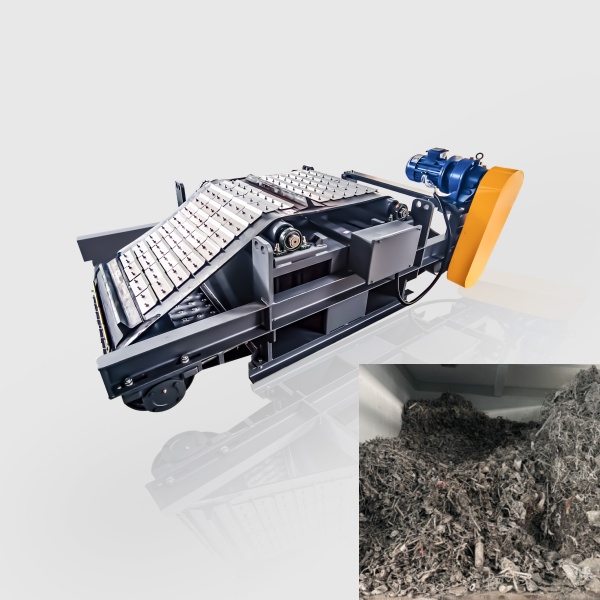
3. Magnetic Separator for Ferrous Metal Recovery
The magnetic separation stage targets ferrous metals such as iron and steel.
Removing ferrous metals early in the process provides a recoverable ferrous fraction while reducing interference with downstream non-ferrous separation.
Depending on the material and plant configuration, different magnetic separation solutions can be considered.
4. Air Separation for Lightweight Materials
Air classification can be added when the ASR contains a significant amount of lightweight fibers, plastics or other low-density materials.
The purpose is to separate lightweight material from heavier fractions and improve the conditions for subsequent metal recovery.
Air separation is not necessarily required in every ASR plant. Its value depends on the feed composition and the desired final products.
5. Eddy Current Separator for Non-Ferrous Metals
After ferrous removal and appropriate material preparation, an Eddy Current Separator can recover conductive non-ferrous metals.
Typical target materials may include:
- Aluminum
- Copper
- Zinc
- Other conductive non-ferrous metals
For auto shredder residue metal recovery, ECS is particularly valuable when non-ferrous metals are mixed with plastics, rubber and other non-metallic materials.
However, its performance still depends heavily on particle size, liberation and feed conditions.

6. Gravity Separation for Fine Heavy Metals
Fine metal particles that remain in the heavy fraction may require an additional separation stage.
A jig machine or other gravity separation equipment can use differences in material density to concentrate suitable heavy particles.
This stage is optional rather than universal. It should be considered when material testing shows that valuable heavy metals remain in the fine or heavy fraction after the primary separation stages.
larly when non-ferrous metals remain mixed with plastics, rubber and other non-metallic materials.
Why Use Multiple Separation Stages?
One machine cannot effectively handle every fraction of ASR.
Screening, magnetic separation and eddy current separation have different functions:
| Processing Stage | Main Function |
|---|---|
| Drum Screen | Classifies ASR by particle size |
| Magnetic Separator | Recovers ferrous metals |
| Eddy Current Separator | Recovers suitable non-ferrous metals |
The purpose of combining these machines is not simply to add more equipment. It is to create a progressive separation process, allowing each machine to focus on the material it is designed to handle.
This can help reduce metal loss and improve the quality of recovered fractions.
How to Select ASR Recycling Equipment
Choosing an ASR recycling machine requires more than looking at the rated capacity.
》Feed Composition
Determine the proportion of ferrous metals, non-ferrous metals, plastics, rubber, glass and fines in the ASR.
》Particle Size Distribution
The size range of the feed determines the appropriate screening and downstream separation configuration.
》Required Capacity
The equipment should be matched to the required throughput rather than selected only according to maximum theoretical capacity.
》Recovery Targets
A plant designed mainly for ferrous recovery may require a different configuration from one targeting both ferrous and non-ferrous metals.
》Site and Operating Conditions
Available space, feeding method, maintenance conditions and local operating requirements should be considered during system design.
》Customization
Because ASR composition varies, a practical recycling system should be designed around the actual material. Material testing can help determine suitable equipment combinations and process parameters.
The Economic Potential of ASR Recycling
The value of ASR recycling comes from several potential benefits rather than a single revenue stream.
》Recover Valuable Metals
Recovered ferrous and non-ferrous metals can become saleable secondary raw materials, depending on their purity and market requirements.
》Reduce Disposal Volume
Recovering recyclable materials can reduce the amount of ASR requiring final disposal.
》Lower Disposal Costs
Where landfill or other disposal costs are significant, reducing residual waste volume can improve the overall economics of the recycling process.
》Recover More Value From Existing Feedstock
Better separation can turn material previously treated as residue into additional recyclable resources.
The actual return on investment depends on ASR composition, processing capacity, metal recovery rate, product quality, local disposal costs and secondary-metal prices. Therefore, an economic evaluation should be based on the specific project rather than a fixed recovery figure.

Building the Right ASR Recycling Plant
A successful ASR recycling system is not simply a combination of individual machines.
The screening stage needs to prepare suitable material for separation. Magnetic separation needs to remove ferrous metals effectively, while the ECS should receive material within its suitable operating range.
This process-oriented approach helps create a more stable ASR recycling plant and provides a better foundation for long-term metal recovery.
For different ASR materials, the configuration may also be expanded with additional crushing, sorting or material-cleaning stages where required.
Conclusion
ASR recycling is moving from waste disposal toward resource recovery.
The right ASR recycling machine can help recover valuable ferrous and non-ferrous metals from auto shredder residue through staged size classification and separation.
For each project, the most effective solution starts with the actual ASR composition, particle size, processing capacity and recovery target.
RUIJIE provides customized recycling equipment and complete ASR recycling plant solutions, with the process configured around the customer’s material and production requirements.